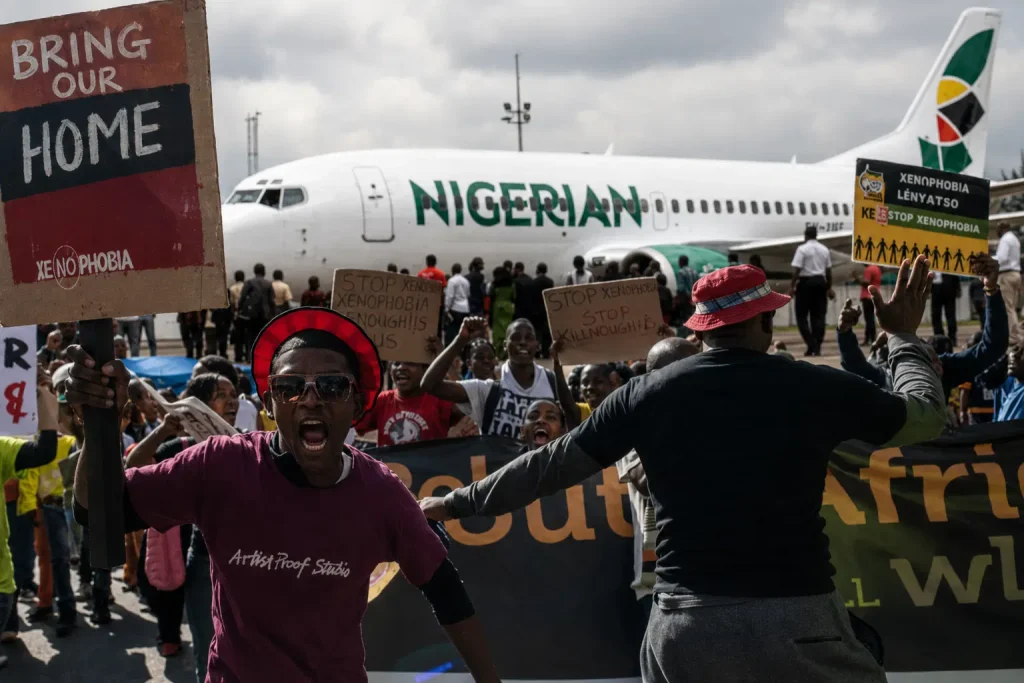
The Federal Government has begun arrangements to evacuate Nigerians willing to return home from South Africa following renewed anti-foreigner protests and growing tensions targeting migrants in parts of the country.
Nigeria’s Minister of Foreign Affairs, Bianca Odumegwu-Ojukwu, disclosed this after a telephone conversation with South Africa’s Minister of International Relations and Cooperation, Ronald Lamola, over recent demonstrations and reports of hostility against foreigners, particularly in Durban.
According to Odumegwu-Ojukwu, the Nigerian government cannot remain silent in the face of continued harassment, intimidation, and alleged extra-judicial killings involving Nigerians living in South Africa.
“Our government cannot stand by and watch the systematic harassment and humiliation of our nationals resident in South Africa,” she stated, adding that the evacuation of Nigerians willing to return home has become a priority.
The minister said although recent protests in Durban did not escalate into violence due to heavy security deployment, the Nigerian Mission advised citizens in affected areas to remain indoors and temporarily shut their businesses for safety reasons.
She also raised concerns over inflammatory rhetoric and increasing hostility from anti-foreigner groups, warning that the situation poses serious threats to the lives and property of Nigerians and other African migrants.
Odumegwu-Ojukwu revealed that several Nigerian families had reported cases of bullying involving Nigerian children and children born to Nigerian-South African parents, commonly referred to as “Sougerians.”
According to her, some children were allegedly mocked in schools and told to “return to their country,” a development she described as disturbing and psychologically damaging.
She disclosed that South African authorities acknowledged the issue and pledged to work with relevant education agencies to address the matter.
The minister further questioned the continued description of the attacks as xenophobia, arguing that black Africans appear to be the primary targets.
“The demand that all foreigners leave South Africa appears targeted only at black Africans, making one wonder whether this should be more accurately described as Afrophobia rather than xenophobia,” she said.
She also announced that President Bola Ahmed Tinubu has directed Nigerian missions in South Africa to establish crisis notification centres to assist Nigerians facing threats or distress.
Meanwhile, calls for economic retaliation against South African companies operating in Nigeria have continued to grow.
Senator Adams Oshiomhole reportedly suggested revoking the operating licences of major South African-linked firms including MTN Nigeria and MultiChoice, while the National Association of Nigerian Students (NANS) threatened demonstrations against South African businesses.
However, economic experts have warned against imposing blanket sanctions, arguing that such measures could damage Nigeria’s economy and undermine investor confidence.
Analysts noted that companies such as MTN, MultiChoice, Stanbic IBTC, and Shoprite employ thousands of Nigerians and contribute significantly to tax revenues, financial inclusion, and digital infrastructure.
Economists including Muda Yusuf of the Centre for the Promotion of Private Enterprise (CPPE) cautioned that retaliatory actions would amount to “economic self-sabotage,” stressing that the attacks are largely driven by socio-economic challenges within South Africa rather than official government policy.
Others urged the Federal Government to prioritise diplomacy, stronger consular support, evacuation frameworks, and international advocacy through bodies such as the African Union and the United Nations.
The Nigerians in Diaspora Commission (NIDCOM) also defended Nigeria’s diplomatic approach, insisting that continuous engagement remains the most realistic path toward resolving the recurring attacks on Nigerians in South Africa.