From explosive terrorism rulings to politically charged election battles, 2025 was nothing short of a rollercoaster in Nigeria’s courts.
The judiciary didn’t just interpret the law this year—it made headlines, shaped politics, and stirred public debate like never before.
Across the nation, judges delivered verdicts that sent shockwaves through governments, political camps, and even the streets, while high-profile convictions, controversial pardons, and unprecedented rulings kept citizens glued to every headline.
In the north, the designation of a violent sect as a terrorist organization marked a historic stand against extremism.
In the south, the Supreme Court’s annulment of local elections ignited political fireworks, prompting emergency measures by the president.
And in between, scandals of electoral fraud, massive recovered funds, and legal battles over digital taxation reminded Nigerians that the courts are no longer just arbiters of law—they are powerful players on the national stage.
2025 proved that in Nigeria, the gavel can be as mighty as the ballot, and sometimes, far more dramatic.
Here’s a closer look at the year’s courtroom battles that captivated the nation.
Lakurawa Sect Officially Declared Terrorist Organization
In January, the Federal High Court in Abuja designated the Lakurawa sect as a terrorist organization.
The group had drawn national attention after a string of violent attacks in north-western Nigeria in late 2024, including a deadly assault in Mera village, Augie LGA, Kebbi State, which claimed at least 15 lives.
The ruling also targeted similar extremist networks operating across north-west and north-central Nigeria, reinforcing the government’s crackdown on violent militancy.
Supreme Court Nullifies Rivers State LG Elections
February saw the Supreme Court invalidate the October 2024 local government elections in Rivers State.
The court found that the Rivers State Independent Electoral Commission (RSIEC) failed to comply with Section 150(3) of the Electoral Act.
Additionally, the court upheld a prior federal high court decision that restricted the release of monthly statutory allocations to the state, while directing the Martins Amaewhule-led assembly faction to resume sittings.
The decision was seen as a win for Nyesom Wike’s camp and a blow to Governor Siminalayi Fubara’s supporters, ultimately prompting President Bola Tinubu to impose emergency rule in March.
Adamawa Farmer Granted Pardon After Death Sentence
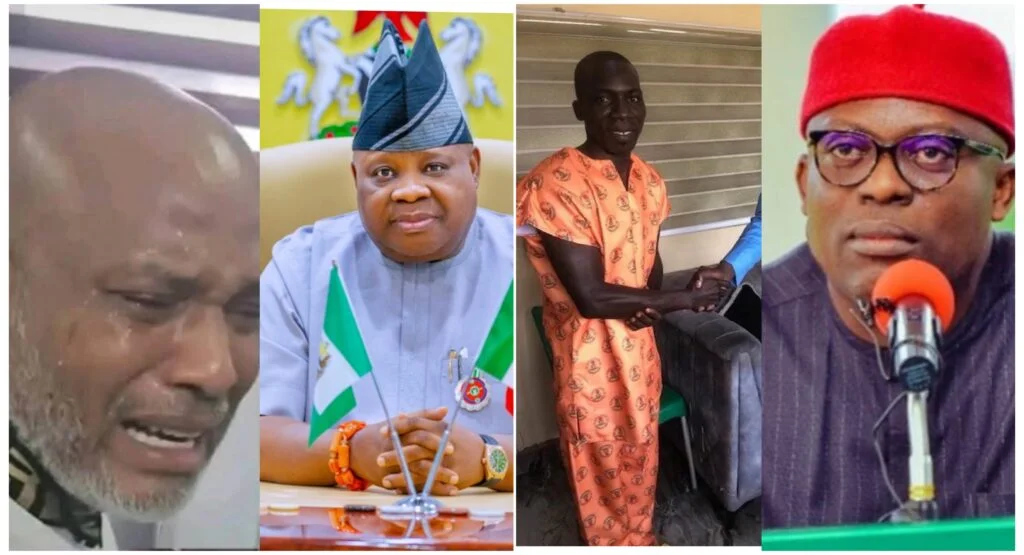
Sunday Jackson, an Adamawa farmer sentenced to death for killing a herder in self-defense, was pardoned by Governor Ahmadu Fintiri in December.
Jackson had been convicted in February 2021, and both the Court of Appeal (2022) and the Supreme Court (March 2025) had upheld the sentence, despite public outcry.
The pardon, timed for Christmas and New Year, brought relief to a case that had sparked nationwide debate on self-defense and rural violence.
Court of Appeal Upholds Electoral Fraud Conviction
In April, the Court of Appeal in Calabar affirmed the conviction of Professor Peter Ogban of the University of Calabar for manipulating the 2019 Akwa Ibom north-west senatorial election results.
Ogban, serving as returning officer, had altered results to favor APC candidate Godswill Akpabio.
Originally sentenced in 2021 to three years in prison and fined ₦100,000, the verdict reinforced the judiciary’s stance against electoral malpractice.
Governors Lose Fight Over ₦1.8 Trillion in Recovered Funds
In May, the Supreme Court dismissed a lawsuit by Nigeria’s 36 states and the Governors’ Forum challenging the federal government’s management of recovered looted assets.
The court ruled that it lacked jurisdiction, directing the case to the federal high court.
The dispute centered on recovered funds, including ₦1.836 trillion, vehicles, properties, and crude oil seized between 2015 and 2021.
FIRS Authorized to Collect VAT on Digital Services
July brought a victory for the Federal Inland Revenue Service (FIRS) as a Lagos federal high court affirmed its authority to collect VAT on transport and food services provided via digital platforms like Bolt.
The ruling upheld a tax appeal tribunal’s earlier decision, confirming FIRS’ power to appoint platform operators as VAT collection agents.
Federal High Court Blocks Pat Utomi’s Shadow Government
In October, the Federal High Court in Abuja restrained political economist Pat Utomi from establishing a shadow government, ruling it unconstitutional under Nigeria’s presidential system.
The Department of State Services (DSS) had filed the suit, citing potential threats to governance and legal order.
Nnamdi Kanu Sentenced for Terrorism
IPOB leader Nnamdi Kanu was convicted of terrorism by the Federal High Court in Abuja in November, receiving a life sentence alongside additional terms of 20 years and five years for other offenses.
His trial, which resumed after his 2021 extradition from Kenya, concluded under Judge James Omotosho, ending one of the nation’s most closely watched legal proceedings.
Supreme Court Dismisses Osun LG Fund Suit
In December, the Supreme Court rejected Osun State’s suit challenging the federal government over withheld local government allocations.
In a 6–1 ruling, the court held that only elected LGA chairpersons have standing to sue over such funds, while acknowledging the federal government’s action as unconstitutional.
Supreme Court Upholds Rivers State Emergency Rule
Also in December, the Supreme Court affirmed President Bola Tinubu’s March emergency rule in Rivers State.
You May Like: Akwa Ibom Police Arrest Masquerades Over Ekid Day Violence
The judgment validated the president’s authority to suspend elected officials and intervene in governance to maintain law and order, following a challenge by Adamawa and ten other PDP-led states.