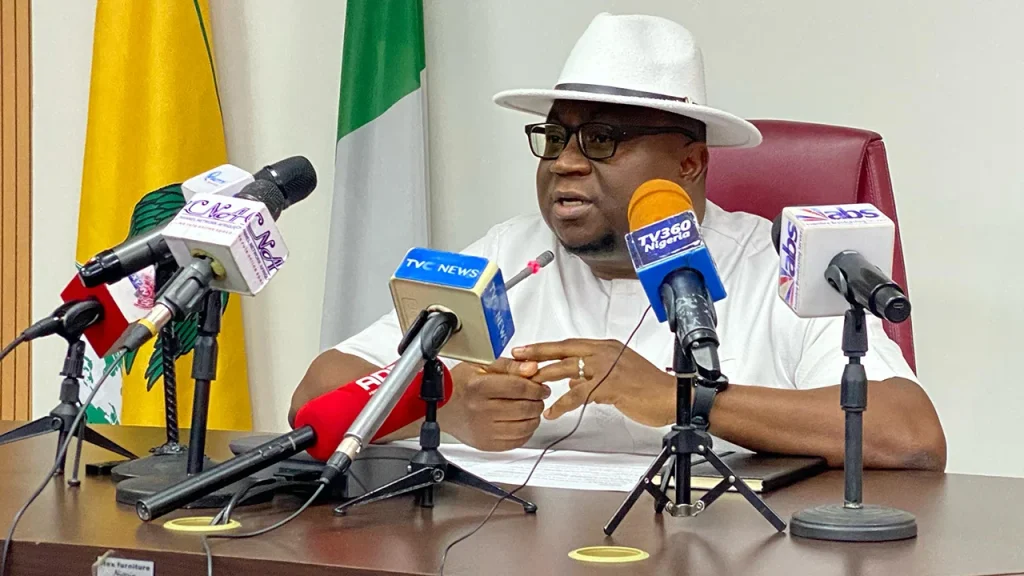

The Petroleum and Natural Gas Senior Staff Association of Nigeria (PENGASSAN) has raised serious concerns over the Federal Government’s plan to dispose of its entire equity in Nigeria’s state-owned refineries, cautioning that a total sale would undermine the country’s energy security and expose it to supply risks.
Speaking on Sunday Politics, PENGASSAN President, Festus Osifo, clarified that the union is not opposed to privatisation itself, but strongly rejects any move that would see the government relinquish complete ownership of the refineries.
According to Osifo, handing over 100 per cent of the assets to private investors would deprive the government of control over infrastructure that is vital to national stability, particularly during periods of supply disruption or global price volatility.
“Once the government sells off everything, it loses all control,” he said. “That is why we believe selling 100 per cent of the refineries would be harmful to Nigeria’s energy security.”
Refineries Are Strategic Assets
Osifo stressed that oil refineries should not be treated solely as profit-driven enterprises, noting that they play a crucial role in ensuring steady fuel availability, cushioning price shocks, and safeguarding national interests in times of emergency.
He explained that PENGASSAN has, for decades, encouraged the Federal Government to reduce its stake in the refineries—but never to fully exit ownership.
“Even before my tenure, and as far back as the era of Comrade Peter Esele, PENGASSAN had consistently advised government to sell part of its shares,” he said. “Our concern has always been about energy security.”
Union Backs Partial Sale Model
As an alternative, the union is advocating for a mixed ownership structure in which the government sells a controlling 51 per cent stake while retaining 49 per cent on behalf of Nigerians.
Osifo explained that such an arrangement would allow the private sector to take charge of operations and efficiency, while the government maintains a meaningful stake in a strategic national asset.
“If government sells 51 per cent, operational control naturally shifts to the private sector,” he noted. “But retaining 49 per cent ensures Nigerians still have a strong presence in these assets.”
Past Mistakes and Investor Interest
The PENGASSAN president argued that Nigeria’s downstream sector would be in a far stronger position today if successive administrations had heeded the union’s long-standing recommendations. He attributed the persistent failure of the refineries to political interference, weak maintenance practices, and inconsistent policies.
He also dismissed claims that investors might shy away from government-owned refineries, saying Nigeria’s large population and fuel demand make the assets attractive.
“There will always be investors interested,” Osifo said. “With proper maintenance and freedom from political interference, these refineries can function efficiently.”
Call for Transparent Valuation
Osifo, however, warned that any partial sale must be preceded by a thorough and transparent valuation process to prevent the country’s assets from being sold at undervalued prices.
Also Read: Nigeria Insecurity 2025 Review: Full List of Terrorist Attacks, Killings and Abductions
He cautioned that rushing into privatisation without proper assessment could result in Nigeria losing critical infrastructure for far less than their true worth.
“The government must ensure a complete valuation is carried out,” he said, “so that these refineries are not sold cheaply.”