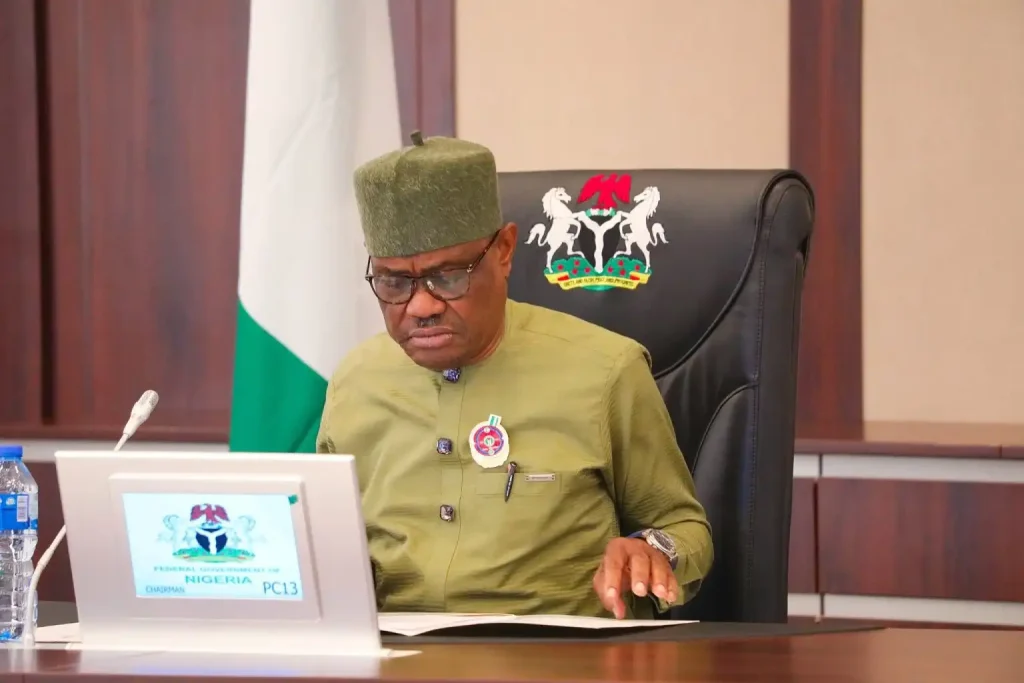
At exactly 58, Nyesom Wike is not supposed to be here.
Not here—at the very centre of President Bola Ahmed Tinubu’s government.
Not here—commanding attention in a cabinet dominated by the ruling party.
Not here—setting the pace in Abuja while many “party men” struggle to explain their relevance.
Yet, here he is.
In a political system obsessed with party loyalty, Wike has done something almost heretical: he made performance louder than ideology.
And in doing so, he has become one of the most talked-about, most controversial, and arguably most influential figures in Tinubu’s administration—without wearing the APC badge.
That contradiction alone is enough to make Nigeria’s political elite uncomfortable.
A Birthday That Exposed A Power Shift
When birthday messages poured in—from President Tinubu himself to Rivers State Governor Siminalayi Fubara—they did more than celebrate a man’s new age.
They inadvertently exposed a political reality many would rather ignore: Wike is no longer just a former governor or a minister. He is a power centre.
Presidents don’t lavish praise casually. Governors don’t publicly celebrate political figures whose influence has waned. Yet, across party lines, the message was the same: Wike is delivering, and everyone sees it.
In a country where ministers often disappear into bureaucracy, Wike has done the opposite.
He has turned the Federal Capital Territory into a theatre of visibility—roads reopened, projects revived, timelines enforced.
The long-stalled Apo–Karshi road alone became symbolic: a 14-year deadlock broken not by rhetoric, but by raw political will.
And that is where the trouble began.
The Problem With Being Too Effective
Wike’s rise in Tinubu’s cabinet has created an uncomfortable question whispered in political circles and shouted on social media:
How did an “opposition” politician become one of the defining faces of this government?
For APC loyalists, it is an irritation.
For PDP purists, it is a betrayal.
For ordinary Nigerians, it is confusing—and fascinating.
Wike did not just cross party lines; he blurred them. He forced a reckoning with a dangerous idea in Nigerian politics: what if delivery matters more than party label?
That idea threatens the entire ecosystem of entitlement politics.
From Rivers Strongman To Abuja Power Broker
Wike’s story did not begin in Abuja. In Rivers State, he built a reputation as a combative, unapologetic political enforcer—loved by supporters, loathed by critics, feared by opponents.
He governed loudly, fought publicly, and built aggressively.
But Abuja is different. It swallows many politicians whole.
Yet, instead of shrinking into protocol, Wike expanded. He brought the same Rivers intensity to the federal capital—bulldozing delays, confronting contractors, and speaking with a confidence that suggests he answers not to party pressure but to results.
That posture alone has elevated him. In a cabinet where silence is often mistaken for loyalty, Wike’s noise has become influence.
The Tinubu–Wike Equation Nobody Wants To Decode
President Tinubu is not sentimental about politics; he is strategic. Which is why the continued prominence of Wike tells its own story.
This is not charity. It is utility.
Tinubu appears to have made a calculation that unsettles traditional party thinking: a performing outsider may be more valuable than a loyal underperformer.
And Wike, aware of this reality, has leaned fully into delivery as his political insurance.
The result? A minister whose relevance does not depend on party meetings or factional protection—but on concrete, asphalt, and visibility.
Why Wike’s Success Is Politically Dangerous
Wike’s Abuja performance is not just impressive; it is destabilising.
It raises uncomfortable comparisons within the cabinet.
It emboldens citizens to ask harder questions.
It weakens the argument that party loyalty alone deserves reward.
Most dangerously, it sends a signal to future governments: competence can disrupt political hierarchies.
That is why Wike attracts both applause and resentment in equal measure.
At 58, The Real Question Isn’t His Age—It’s His Trajectory
As Nyesom Wike marks another year, the debate around him is no longer about where he came from, but where he is going—and what his rise says about Nigeria’s political future.
Also Read: Rivers Proud Of Your Impact In Abuja – Fubara Celebrates Wike At 58 After Joining APC
Is he proof that Nigerian politics can evolve beyond rigid party lines?
Or is he an exception that proves the rule?
Is his influence temporary—or a preview of a new political order where results outweigh allegiance?
One thing is clear: you cannot ignore him.
At 58, Wike is not winding down. He is peaking—right at the heart of power, in a government he was never “supposed” to dominate.
And that, more than any birthday message, is what has truly shaken the system.