The House of Representatives has opened deliberations on President Bola Ahmed Tinubu’s 2026 Appropriation Bill, giving early backing to a ₦58.18 trillion spending plan aimed at stabilising Nigeria’s economy, strengthening security, and accelerating capital investment.
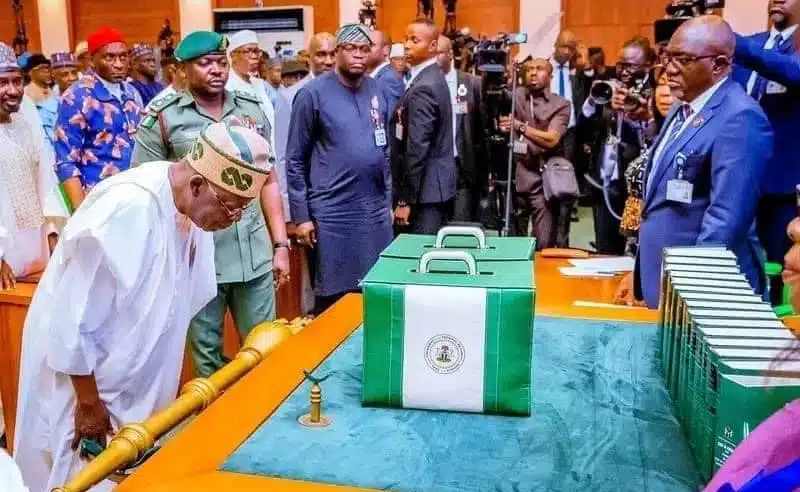
Tagged “The Budget of Consolidation, Renewed Resilience and Shared Prosperity,” the proposal was formally laid before the National Assembly on December 19, 2025.
Lawmakers described it as a critical step in the administration’s broader effort to restructure and reposition the nation’s economy after years of fiscal strain.
Leading the debate on the bill’s general principles, House Majority Leader, Rep. Julius Ihonvbere, said the Tinubu government assumed office amid weakened institutions and entrenched economic distortions, warning that meaningful reform would inevitably involve difficult choices.
According to Ihonvbere, long-term progress cannot be achieved without sustainability, noting that short-term sacrifices are necessary to lay the foundation for enduring growth.
He urged Nigerians to view ongoing economic adjustments as investments in the country’s future rather than temporary hardships.
To support the House’s endorsement of the budget, the lawmaker pointed to improving macroeconomic indicators, including a projected 3.98 per cent growth rate in 2026 and a significant reduction in inflation to 14.45 per cent from nearly 25 per cent. He also cited rising government revenues, stronger export performance, and increasing foreign direct investment as signs of economic recovery.
Ihonvbere further highlighted improvements in Nigeria’s external position, noting that the naira has strengthened to about ₦1,400 to the dollar, compared to over ₦1,800 previously, while foreign reserves have risen to approximately $47 billion — their highest level in seven years — enough to finance more than ten months of imports.
Emphasising fiscal restraint, he said the current administration has refrained from deficit financing through money printing, a move he credited with helping to stabilise the economy and restore investor confidence.
Under the proposed budget framework, total government revenue is estimated at ₦34.33 trillion, while projected spending stands at ₦58.18 trillion, leaving a fiscal deficit of ₦23.85 trillion. Non-debt recurrent expenditure is set at ₦15.25 trillion, while capital expenditure is allocated ₦26.08 trillion — a spending pattern lawmakers described as a decisive shift toward development-oriented investments.
Unlike previous budgets where recurrent costs dominated, the 2026 proposal places greater emphasis on capital projects, which Ihonvbere said are essential for driving infrastructure growth, job creation, and long-term productivity.
The budget is based on key assumptions, including an oil price benchmark of $64.85 per barrel and daily crude oil production of 1.84 million barrels. Major sectoral allocations include ₦5.41 trillion for security and defence, ₦3.56 trillion for infrastructure, ₦3.54 trillion for education, and ₦2.48 trillion for health.
Lawmakers also drew attention to the administration’s intensified international engagements, including recent diplomatic and economic missions to countries such as Türkiye, aimed at improving Nigeria’s business climate and attracting foreign investment.
Members of the House stressed that the appropriation bill represents more than fiscal projections, describing it as a policy statement reflecting commitments to revenue expansion through tax reforms, blocking financial leakages, maintaining macroeconomic stability, and strengthening human capital development.
While acknowledging that the government is not without flaws, Ihonvbere said it remains the responsibility of lawmakers, as representatives of Nigeria’s 360 constituencies, to provide guidance and oversight to ensure the right policy choices are made.
Following extensive debate, the Speaker called for a voice vote, which passed overwhelmingly in favour of the bill. The House subsequently approved the budget for second reading and adjourned plenary for a two-week recess to allow for detailed budget defence by ministries and agencies.
Also Read: Ndume Slams Akpabio Over Alleged Discrepancies in New Tax Law
Describing the budget as both a commitment and a vision, Ihonvbere said collective effort would be required to translate it into tangible benefits for Nigerians, not only now, but for generations to come.