
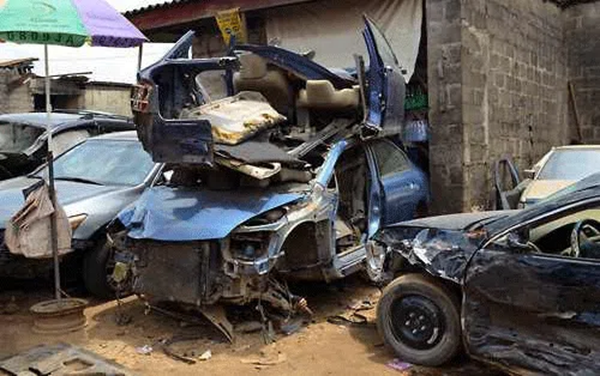
Nigeria’s Federal Government is preparing to unlock a major new revenue stream by formalising the country’s largely informal vehicle recycling sector, with projections showing the initiative could generate more than ₦150bn annually from 2026.
The plan was unveiled by the National Automotive Design and Development Council (NADDC), whose Director-General, Joseph Osanipin, said the strategy is anchored on a newly approved End-of-Life Vehicle (ELV) programme designed to modernise the automotive industry while tackling environmental and safety risks.
Under the scheme, vehicles that have reached the end of their usable life will be formally collected, dismantled and recycled, replacing the current practice of roadside abandonment and unregulated scrapping. Osanipin described the shift as turning a long-standing problem into a structured economic opportunity.
He explained that the policy would mirror practices in advanced economies, where vehicle owners contribute a small fee during registration to cover the cost of safe disposal and recycling at the end of a vehicle’s lifespan. Although the approach may initially meet public resistance, he said it is critical for building a sustainable automotive ecosystem.
Nigeria already operates a vast informal market for used auto parts—popularly known as the Belgian parts market—which Osanipin said reflects consumer concerns about the quality and durability of many new components. According to studies by the council, more than 85 per cent of parts from end-of-life vehicles can still be reused or recycled, offering a strong base for a formal circular economy.
Rather than leaving derelict vehicles to degrade the environment, owners would be incentivised to hand them over for recycling and earn value in return. If properly managed, Osanipin noted, the system could generate billions of naira annually while supporting thousands of jobs in dismantling, refurbishment, logistics and parts resale.
The announcement comes at a time when Nigeria’s auto import market is showing signs of recovery. Data recently cited by The PUNCH indicate that passenger vehicle imports were valued at about ₦1.01tn in the first nine months of 2025, compared with roughly ₦894bn in the same period a year earlier. Figures from the National Bureau of Statistics suggest momentum picked up significantly in the second half of the year, with a strong third-quarter performance offsetting earlier slowdowns.
While the rebound highlights renewed confidence—particularly in the fairly used, or “Tokunbo,” segment—it also exposes ongoing challenges such as high import costs, currency risks and Nigeria’s heavy reliance on foreign vehicles.
To address quality concerns, the NADDC plans to introduce mandatory pre-export certification for all used vehicles shipped to Nigeria starting in 2026. The measure is aimed at stopping the country from becoming a dumping ground for rusted and unroadworthy vehicles. Osanipin said exporters, not Nigerian buyers, would bear the cost of certification.
He recounted discussions with a foreign exporter who admitted sending multiple containers of end-of-life vehicles to Nigeria simply because it offered the highest returns. The new rules, he said, would ensure importers clearly understand the condition of vehicles before purchase.
Beyond recycling and imports, the council is also pushing ahead with alternative energy reforms, including converting petrol and diesel vehicles to electric and compressed natural gas (CNG) systems. Osanipin said extensive training programmes are already underway for regulators, technicians and industry players in electric vehicle technology, CNG retrofitting and vehicle conversion.
National Occupational Standards for EV maintenance and CNG conversion have been developed, with formal certification programmes expected to roll out in 2026.
He added that local capacity is steadily improving, with Nigerian engineers and students working on vehicle designs such as tricycles, buses and electric shuttle vehicles in partnership with 12 universities and private firms.
According to Osanipin, real value in the automotive industry lies in component manufacturing rather than full vehicle imports. He noted that Nigeria spends more each year on items such as tyres, brake pads, filters and batteries than it does on importing complete cars. The council is therefore engaging stakeholders to resolve infrastructure, funding and policy challenges facing local manufacturers, particularly as Nigeria positions itself to leverage opportunities under the African Continental Free Trade Area.
To provide stronger legal backing for these reforms, the NADDC plans to push for the National Automotive Industry Development Plan to be enacted into law. Osanipin revealed that a draft Auto Industry Bill would soon be submitted to the National Assembly, stressing that the scale of investment required in the sector demands legislative support.
Also Read: Taiwo Oyedele Warns Workers Will Stay Overtaxed if Tax Laws Are Delayed
Acknowledging that some of the reforms may attract criticism, he appealed to the media to help communicate their long-term benefits to the public, describing 2026 as a turning point for Nigeria’s automotive industry.